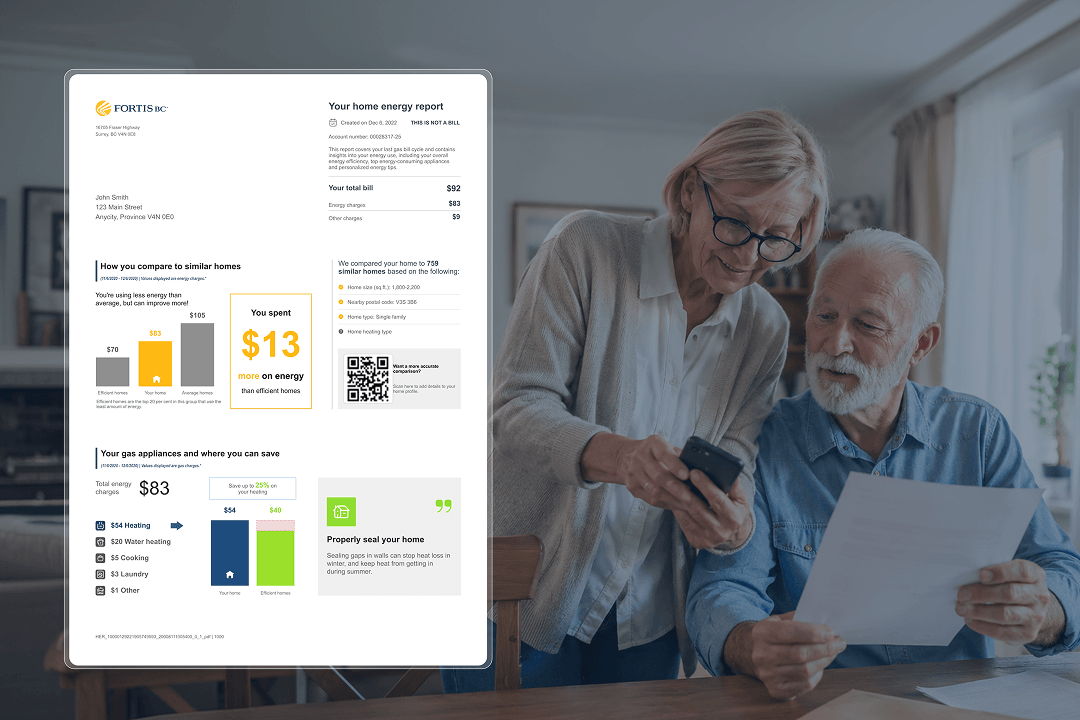
Most utilities running a mature home energy report program eventually reach the same decision point. The program is performing and the savings are real, but the landscape has evolved since the contract was signed as new capabilities have emerged and customer expectations have changed. So what comes next?
FortisBC launched their My Energy Use program to gas customers in December 2020 and electric customers in June 2021, delivering reports by paper and email to roughly 92,000 customers six times a year.
Over five years, My Energy Use delivered more than 440,000 gigajoules in verified savings, enough energy to heat nearly 4,900 homes.
But after five years, it was time to assess the program and take a look at what comes next.
"We are always looking for new and innovative ways to help our customers manage their energy use,” explained Alicia Hearn, Program Manager, Conservation Awareness & Marketing Strategy at FortisBC. "After several years in market, it can be helpful to see what new features are available in the space.”
What FortisBC prioritized
At every step of the My Energy Use rollout, the FortisBC team was testing their approach, gathering data, and acting on what they learned.
For example, in the program's third year, the team introduced a self-compare cohort as a controlled experiment. Rather than comparing a household's usage to similar nearby homes, these reports compared each household to its own usage during the same period a year earlier. The question was direct. Which comparison drives more energy savings?
The experiment reached 40,000 additional customers and produced a clear answer. Normative comparison against similar homes yielded more savings per participant. The finding gave the team something concrete to carry forward, and when FortisBC designed the next generation of the program, normative comparison stayed at its core.
The team was also actively seeking and tracking customer feedback. Customers told the utility they wanted to know how and where they were using energy in their homes. General guidance to use less energy left them without a clear next step.
All of these insights informed what FortisBC was looking for in the next version of this program. Above all, it wanted to deliver personalized recommendations for its customers, grounded in individual household patterns, so that every Home Energy Report was highly relevant to what was happening in each home at that time.
As part of that personalization, the team wanted to be able to identify which customers were the strongest candidates for specific programs, from dual-fuel rebates to weatherization, so outreach could be precise. And they wanted visibility into how consumption correlates with weather and household behaviour, giving customers a fuller picture of what drives their bills.
Bidgely was able to deliver those advanced features.
"What we really liked about Bidgely was the disaggregation," Alicia said. "That's helping us tell customers where and how and when they're using their energy. We wanted to empower our customers with meaningful insights and clear actions they could take, creating a more informed and personalized experience.”
A more disciplined rollout
With the platform decided, attention turned to implementation, again basing important decisions on lessons learned from the program’s launch history.
"When we rolled out our original program, we sent out 80,000 reports all at once," Alicia explained. This time the team wanted room to observe and adjust. “With Bidgely, we did a crawl, walk, run approach, which was phenomenal. That really helped us, because we had the opportunity to pivot if we needed to which was reassuring."
FortisBC began in late January with a soft launch of 500 paper reports to electric customers who had never received a report before. The team watched contact centre volume, monitored the customer inbox, and verified data accuracy before continuing to expand. Paper and digital reports for gas customers followed. By April the full rollout was complete, including personalized Home Energy Reports and a redesigned web portal.
Internal readiness was treated as an integrated part of the launch, not a parallel workstream. Customer service representatives completed training before the first report went out, and nearly 400 customer-facing employees across the province were trained through a train-the-trainer model created by the utility’s Learning Development team, working alongside Bidgely to ensure accuracy. When customers did call, the representatives were ready to walk them through what the reports showed.
The schedule held. "We had our kickoff meeting in June, and we were rolling out in January. We were only delayed by two weeks," Alicia recalled.
Delivering a better customer experience
The measured rollout paid off in customer satisfaction.
"We've had really low call volume, which has been fantastic," Alicia said. Across the January to April launch window, roughly 136,000 reports generated only 110 calls and 59 opt-outs. Email open rates reached 72 percent.
Alicia attributes the program’s customer engagement to the quality of the insights themselves, now grounded in appliance-level disaggregation.
"Now we're able to tell our customers, ‘this is how you're using your energy, this is where you're using it, this is where you can save.’ And we're giving them the proper recommendations and advice and education to take those next steps to help them save energy. We're hearing that the reports are valuable to the customer, because we're giving them advice that makes sense to them based on what's actually happening in their home."
Education as the organizing principle
"Energy savings are important. That's what we're driving towards," Alicia said. "But for us, the reports are also designed first and foremost to help educate and inform our customers on how they are using their energy."
The team treats every report as a customer relationship touchpoint. The savings follow once customers understand their usage and trust the information and advice they receive.
Every utility, regardless of regulatory requirement, can benefit from this same mindset. Customer trust, built through accurate and transparent personalized reporting, makes savings durable over the life of a program.
The day-to-day difference
Bidgely’s operational tools have changed Alicia's own work as well.
She reviews reports before they go out to verify data accuracy. That verification previously required a multi-step process. With Bidgely's CARE portal, it takes a fraction of the time, and the Looker analytics portal gives her direct visibility into customer feedback.
"The time savings have been unbelievable," she said.
Looking ahead
Building on the success of the residential Home Energy Reports program, a second phase extending Business Energy Reports to small and medium commercial customers is on the roadmap for 2027.
In keeping with their proactive, forward-looking approach, the team is interested in exploring Bidgely’s high bill alerts to prevent high-bill surprises, and Analytics Workbench to sharpen program targeting.
"Today we take a broad-based approach with our marketing," Alicia said. "Analytics Workbench would allow us to target our customers with the right message based on where they live and the appliances they have in their home."
The disaggregated insights that power My Energy Use 2.0 have delivered a strong customer engagement foundation that FortisBC is eager to build upon.