Bidgely
Time-Based Rates: From Experimentation to Validation
Author's image
Author: Ted Nielson
TOPICS
TOU

There is no standard playbook when it comes to implementing time-based rates. Time of use pricing structures vary by region. Demand charge approaches vary by market. Critical peak programs vary by grid constraints. Every utility is at the cutting edge of program design with different approaches to solve the same fundamental grid load problems, enrollment hurdles, and affordability concerns. 

Without proven best practices to follow, utilities often default to straightforward analysis. They look at current usage patterns and project bills under the new rate structure, segmenting customers into those who will save money and those who will likely pay more. Unfortunately, enrollment-driven approaches cause revenue leakage—the easy Savers join the rate, but don’t deliver the load shift. Auto-enrollment gets the shift, but your customers have bill shock after bill shock as the months tick by, clogging your call centers with angry and confused rate payers.

A binary approach misses the shades of gray, which includes all those customers who would pay more today on a time-varying rate, but could save significantly with targeted and specific behavior changes. In the short term, it constrains enrollment. But more significantly, over the long term, it overlooks the real opportunity to identify potential savers, coach them effectively, and continuously improve rate performance based on customer engagement and behavior change.

The Promise of Potential Savers

Let’s take a closer look at that third group of potential savers that traditional analysis misses. 

This group might include a customer who charges their EV when they get home at 6pm. Under your new TOU rate, that’s expensive. But if they delay charging until 11pm, they save substantially. It also includes the customer who runs their pool pump all afternoon during peak hours. Shift that to overnight and the rate becomes beneficial. And it includes the customer who could pre-cool their home before peak pricing kicks in, reducing HVAC load during expensive hours.

These potential savers don’t show up in standard analysis. Identifying them requires true disaggregation that reveals not only what appliances customers have, but also when they’re running them. Machine learning disaggregation identifies specific appliance usage down to the time of day. You can see the EV charging from 6 to 8 pm. You can see the pool pump running in the middle of the afternoon. You can see the HVAC ramping up during peak hours.

That visibility changes your segmentation completely. Instead of winners and losers, you have winners, potential savers who become winners with coaching, and a much smaller pool of  customers who don’t benefit at all from time-based rates.

Potential savers don't show up in standard analysis. Identifying them requires true disaggregation.

An Integrated Approach to Time-Based Rates

Rolling out time-based rates successfully requires more than accurate modeling. You need an integrated approach across the customer journey.

1. Segmentation and Targeting

Start with premise-level disaggregation to identify which customers would benefit immediately as well as those who would benefit after implementing behavior change. 

For the group of potential savers, define the personalized coaching they need, based on their actual usage patterns. “Shift your EV charging to after 11pm and save $40 monthly.” “Run your pool pump overnight instead of afternoons and save $25 monthly.” Make the behavioral changes specific, actionable and tied to real savings based on various rate plans and the actual customer usage.

2. Rate Education and Enrollment

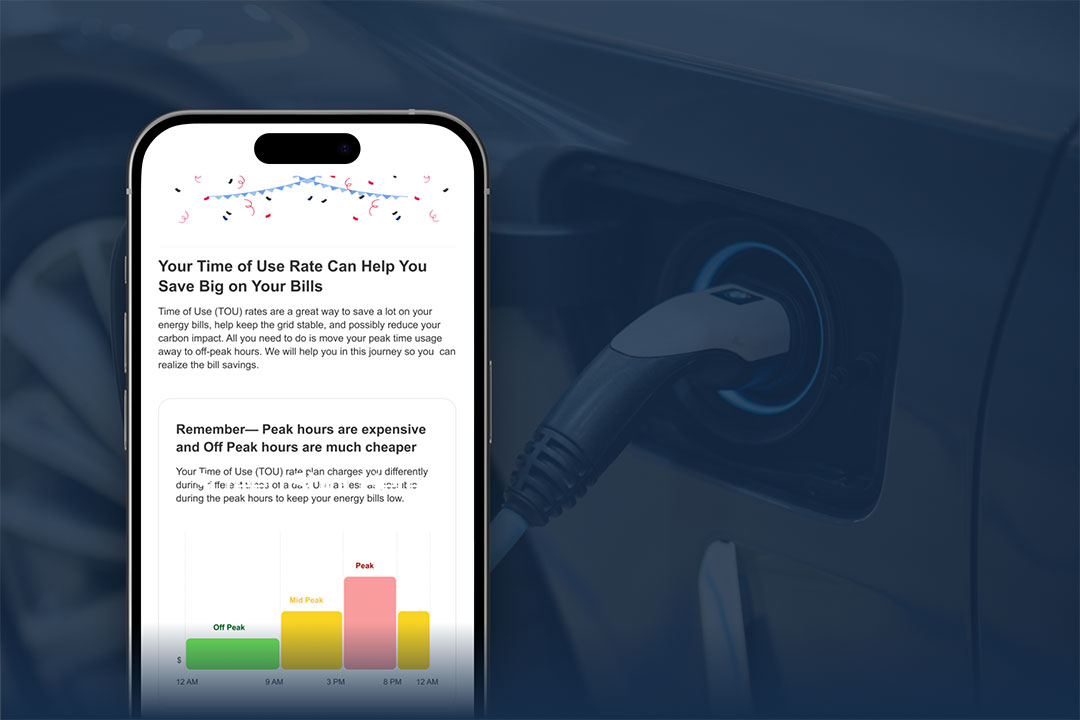
Customers need to understand how the rate will impact them personally. Generic rate education won’t inspire participation. You need to show each individual customer their projected bill under the new rate – both if they continue their current behaviors, and after making recommended changes.

Multi-channel outreach helps, including via email, web portal, mobile app and SMS. Different customers engage through different channels. Your education needs to meet them where they are, in their preferred language.

3. Managing Bill Shock

Even with good education, bill shock happens. A customer may forget to adjust their behavior or seasonal factors could change usage patterns. They need to understand what factors triggered their high bill.

High bill explanations integrated into your customer service workflow help. With access to behind-the-meter usage data, your CSRs can see exactly what behavioral, weather or other factors drove the increase and can present relevant options for the customer to avoid high bills going forward. The same capability enhances the effectiveness of chatbots, IVR systems, and self-service portals.

The key is to provide more than an explanation, and instead teach customers how they can course-correct before the next billing cycle.

4. Measurement and Verification

Implementing time-varying rates requires continuous measurement at a granular level to track what’s working, including enrollment rates by segment, which messaging drives adoption, what type of coaching most effectively changes behavior and how much additional volume hits your CSR team. 

This ongoing data collection enables you to refine messaging, adjust coaching, improve the customer experience and boost program outcomes.

From Experimentation to Validation

Remember the challenge we set out at the start. Every utility is experimenting with time-based rates, without a standard playbook to follow. That creates risk. You’re investing in rate design, customer communications, and system changes without knowing if your approach will deliver the load management outcomes you need.

At Bidgely, our goal is to help utilities mitigate that risk by leveraging best practices and harnessing the behind-the-meter data that is essential to more effective targeting, coaching and program measurement.

Bidgely works with utilities around the world implementing different time-based rate structures, and that experience informs our platform development. Our patented true disaggregation technology provides the premise-level insights that enable accurate segmentation. Our data-driven customer engagement tools let you test different enrollment and personalized coaching strategies. Appliance-level visibility and bill explanation capabilities help your CSRs manage the transition. Near-real-time measurement and verification shows you what’s actually working. Rather than stitching together point solutions from different vendors, we’re working with our customer partners to deploy comprehensive solutions that handle the full customer journey from rate design through ongoing optimization.

And equally important, the lessons we’ve learned around the world help utilities validate and improve their own approaches, providing that time-based rate implementation playbook that utilities really need. 

That’s how you move from experimenting in isolation to building a validated approach that unlocks potential savers. And that’s how you make time-based rates work for both your utility and your customers.

 
Reach out to our team to schedule a live demo.
Base on your interest, we think you might also want to check out: