Bidgely
How PNM is Leveraging AMI Data to Optimize Time-Varying Rates
Author's image
TOPICS
TOU

Recently I had the chance to speak with Patty Torrez, Manager of Digital Customer Experience, and Denine Rothman, Time-of-Day Program Manager, from Public Service Company of New Mexico (PNM) about how they are navigating the complex transition from traditional monthly billing to dynamic pricing structures and grid modernization. 

They told me that PNM’s journey toward grid modernization began well before their plan received final approval from the New Mexico Public Regulation Commission in fall 2023.

“We are in a monthly meter data environment currently, and so we do not have any AMI meters deployed,” Torrez explained. “Our grid mod plan was approved last fall by the New Mexico Public Regulation Commission, but the time-of-day pilot was actually conceived about 18 months before that.”

What struck me about PNM’s approach was their foresight in pursuing parallel tracks. While working through the lengthy regulatory approval process for comprehensive grid modernization, they simultaneously developed their Time-of-Day pilot program through a separate rate case. 

“The TOD pilot was actually proposed as part of a rate case, and was approved separately from our grid mod plan. The folks on our pricing team started thinking about it, probably about the same time that we actually submitted our grid mod plan to the PRC,” Torrez added, highlighting how this strategic separation allowed PNM to proactively begin customer education and behavioral change initiatives well before full smart meter deployment.

Building the Foundation: A Risk-Free Pilot Approach

“We implemented our Time-of-Day program at the beginning of January of 2024,” said Rothman. “Currently, we have 1200 customers who have opted into  the program.”

The pilot features an innovative bill guarantee mechanism, which Rothman said has been central to the program’s success. 

“If a customer spends more on the TOD rate versus what they would spend on the residential rate they were on before the pilot, PNM will credit them the difference after 12 consecutive months of participation,” she explained.

This approach effectively removes customer risk while allowing PNM to gather valuable data on usage patterns and behavioral change across diverse customer segments.

The Importance of Customer Education

Contrary to the assumption that smart meters automatically drive customer savings, Rothman emphasized that technology alone is not the answer. Customer education has been a critically important part of their solution.

“When we first kicked off this program, a lot of people were excited to get the cellular meter for free and thought it would do some sort of magic,” Rothman shared. “But the magic is not in the meter. It’s in the education and the behavioral shifts that you do that deliver the results.”

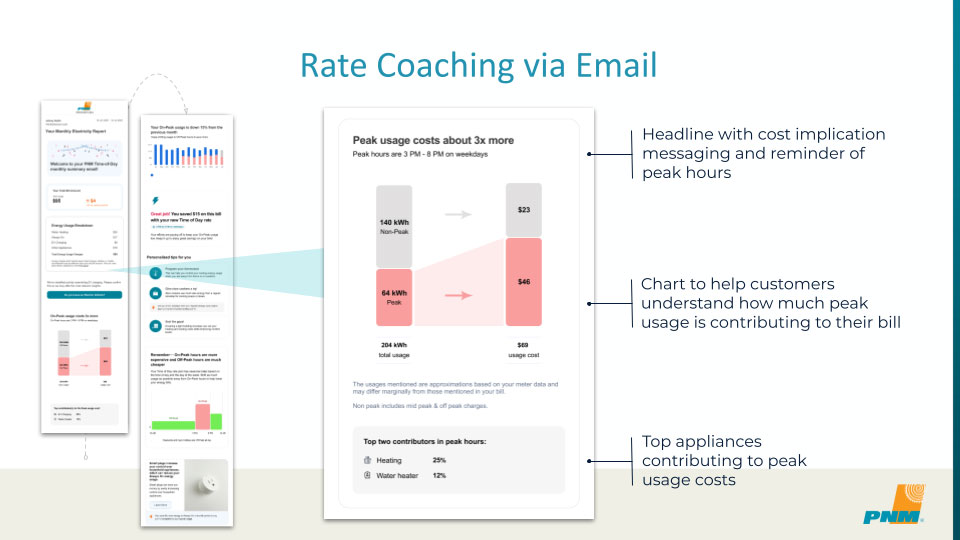
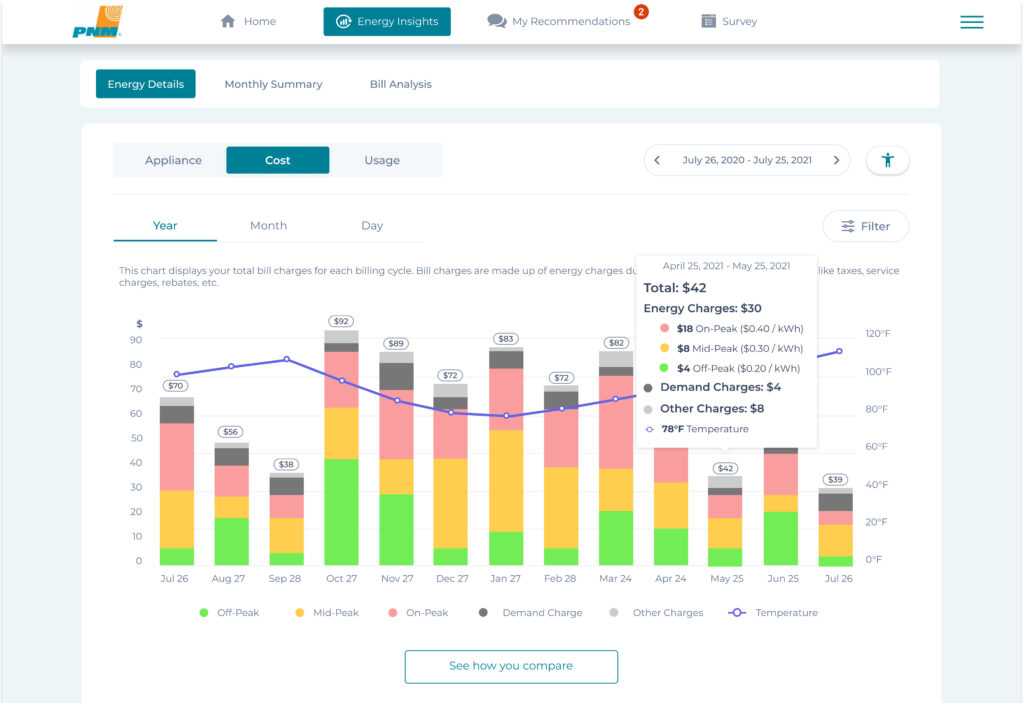
She said it’s this philosophy that has shaped PNM’s approach to customer engagement, focusing on customer enablement rather than just technology deployment. Participating customers receive Bidgely insights that itemize their energy usage by appliance, by day and by hour. They also receive budget alerts. 

“We want to be able to empower and educate our customers. We want to equip them with the tools and resources to save money on peak hours,” she said.

“The interval usage data and this TOD pilot are really giving our customers a lot more insight into how they use their energy and the control that they have to make changes and to start using their energy differently so they can see those savings,” added Torrez.


Inclusive Customer Participation

PNM had an inclusive opt-in strategy for the pilot, which has attracted unexpected participants. For example, 98 solar customers were able to enroll, despite uncertainty about potential savings for this segment. They’ve also focused on education and awareness within low- and fixed-income segments. By including all customer types, PNM has been able to gather more comprehensive data for future rate design.

When it comes to impact, PNM has seen impressive pilot results across customer segments, with remarkable retention and savings.

“With our commercial customers, we have a 0% cancellation rate. And year to date, our commercial customer participants have saved over a million dollars just by being on the rate,” Rothman reported. 

With our commercial customers, we have a 0% cancellation rate. And year to date, our commercial customer participants have saved over a million dollars just by being on the rate.

But perhaps even more compelling was a story she shared about a residential customer who achieved extraordinary savings through family-wide behavioral change. 

“I just talked to a gentleman who actually saved over $1,000 in a year by engaging his whole household in the effort,” she said. “It was a family effort race. Once we educated him about when the off-peak and on-peak hours were, he got his kids on board,” Denine explained. “They were just very conscious as far as the time that they were using their bigger appliances, and really just conscious about their energy usage, as far as using appliances, turning off lights, unplugging their devices… those types of things.”

Bridging PNM to Its AMI Future

Torrez and Rothman emphasized how the pilot is serving as a crucial stepping stone, reinforcing that customer experience has to be the guiding principle. The lessons learned from the pilot are directly informing their approach as AMI deployment will kick off in phases next year. 

“We can’t control rates, but we can control the experience our customers have and the tools and the resources that we provide them to improve that experience,” Rothman said.

This focus extends to proactive customer support, she added.

“We’ve had a lot of success stories as far as people calling and wondering why their bills are high. And before we had appliance-level analytics, we didn’t have the insights to definitively explain the cause – to be able to say, ‘it looks like you have an electric vehicle.’”

Torrez agreed that the benefits of the pilot have accrued to customer support, not only when it comes to customer satisfaction, but also by improving operational efficiency.

“The proactive communication that our TOD pilot customers receive in their monthly summary emails drives down calls to our contact center, and decreases the length of those calls,” she said.

Lessons for the Industry

PNM’s pilot approach reveals a number of helpful lessons for utilities in similar circumstances.

  1. Start with pilot programs to fine tune your approach. 
  2. Amplify new technology roll-outs with customer education to achieve more durable behavioral change and program success.
  3. Remove risk barriers with mechanisms like bill guarantees to boost enrollment and customer confidence.
  4. Maintain flexibility and adapt business processes as you learn. 

The Time-of-Day pilot demonstrates that with proper planning, customer education, and risk mitigation, utilities can successfully introduce dynamic pricing while maintaining – and even improving – customer satisfaction. The transition to more sophisticated rate structures doesn’t have to be disruptive. It can be empowering for customers and beneficial for the grid when executed with care and strategic vision.

As PNM prepares for full AMI deployment and permanent TOU rate structures, their pilot continues to provide valuable insights that will benefit not just their customers, but the broader utility industry. 

To hear more from Denine and Patty, watch the full-length webinar on demand.

Base on your interest, we think you might also want to check out: