Utilities have invested millions in programs designed to help customers who need them most, from weatherization assistance and arrearage management to appliance upgrades and energy burden relief. Yet in market after market, enrollment lags behind projections. Utilities are not failing to fund income-qualified programs. We are failing to identify, prioritize, and engage the right households at scale.
The missing piece isn’t more funding or more programs, it’s premise-level intelligence.
Only with behind-the-meter insights can you granularly identify best-fit customers, engage them through the channels they trust, and measure what’s working so you can improve over time.
Most utilities rely on publicly available zip code data for income qualification. Some have advanced to census block level targeting, which offers about 17 times more granularity than zip codes. However, both approaches cast too wide a net and often miss eligible customers.
For example, a customer might earn $80,000 annually. They are above the LIHEAP threshold, but their monthly energy bill averages $800. So even though they’re energy burdened and spend a disproportionate share of their income on utilities, both zip code and census block targeting will fail to identify them as a program candidate.
Weatherization programs have the same issue. Utilities are seeking income-qualified customers with inefficient HVAC or degraded appliances who would actually benefit. Doing so accurately requires understanding household economics and energy usage at the premise level, not the neighborhood level.
The consequences of coarse targeting include enrollment shortfalls, regulatory scrutiny over equity outcomes, and rising arrearage that compounds territory-wide challenges. Across every metric, premise-level intelligence is the foundation for improving income-qualified performance. But that foundation only works when it’s integrated at every stage of the income-qualified program journey.
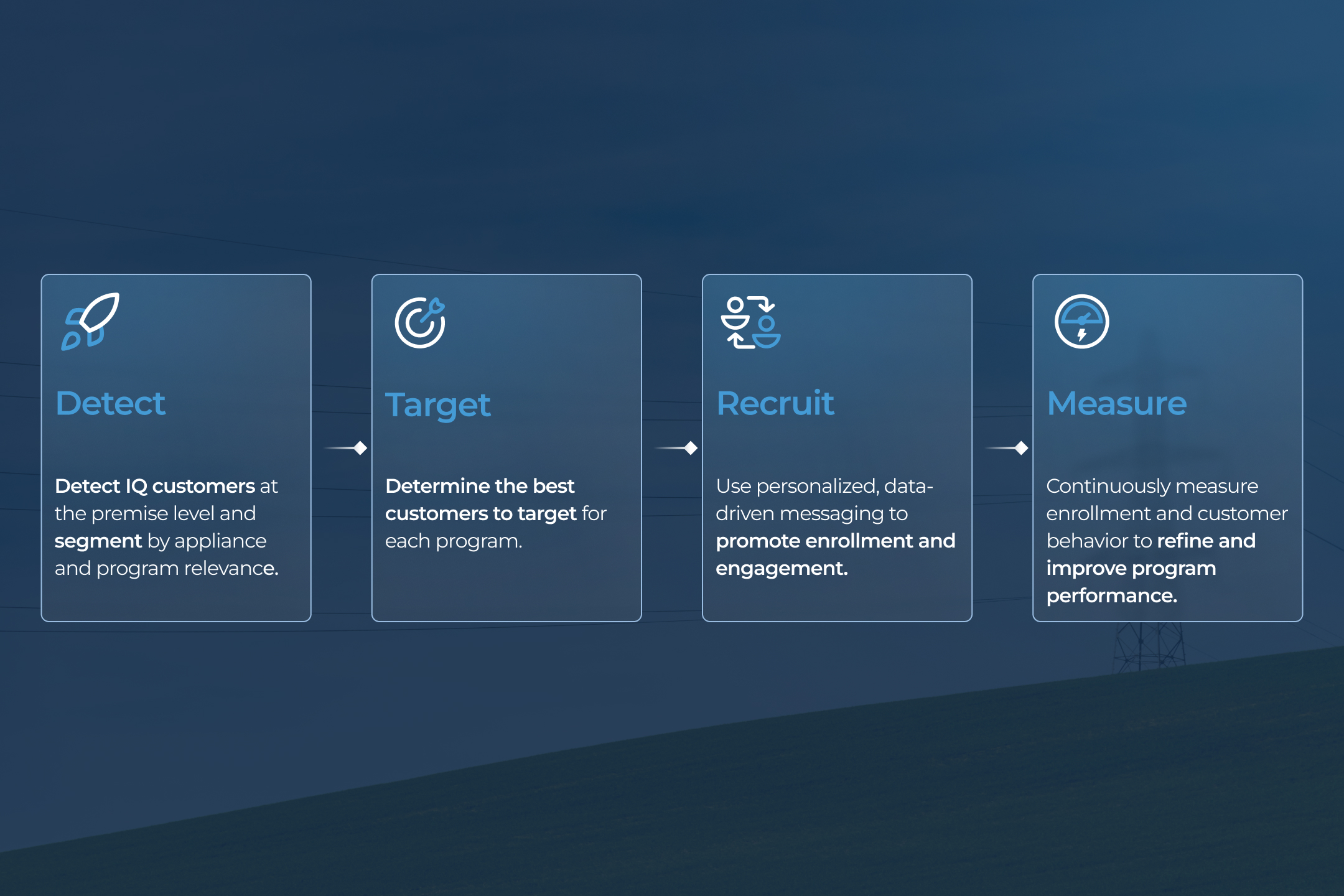
Success with income-qualified programs depends on three interconnected components:
Anyone can pull zip code income data. It’s publicly available. Census block data is better, but still limited. The key is to tap into premise level insights by leveraging the utility data you already have.
Appliance-level usage patterns is a logical place to start. Disaggregation technology reveals not just what appliances customers own, but how they’re being used. That matters because inefficient HVAC systems, degraded water heaters, and high-consumption appliances signal both energy burden and weatherization opportunity.
Next, layer on bill payment history, program enrollment and other inputs like census data and demographic information to build a comprehensive picture of each household. This data-driven approach moves you beyond a simple yes/no income qualification flag to an analysis that reveals the likelihood a household falls into a specific income range.
Different programs have different thresholds and preconditions. When you’re managing a portfolio of programs for veterans, energy burdened households, weatherization candidates, arrearage management, and more, premise-level data lets you pinpoint the customers best suited for every program with a precision you can’t achieve at the zip code or census block data alone. And because this targeting updates continuously, you’re working with fresh eligibility data, not annual snapshots. This means better leads for program implementers and community-based organizations.
Once you know who can benefit from a given program, you need to determine the best way to reach them.
At a recent industry roundtable, utility executives shared something telling: when they call income-qualified customers directly, people don’t answer, because they fear the call is about their bill. This is particularly true of rural customers who are statistically more likely to be income-qualified but also more likely to distrust utility communications.
With that in mind, utilities have turned to partnerships with trusted community organizations like The Salvation Army, food banks and faith organizations and other groups that already have relationships with the communities that need help most.
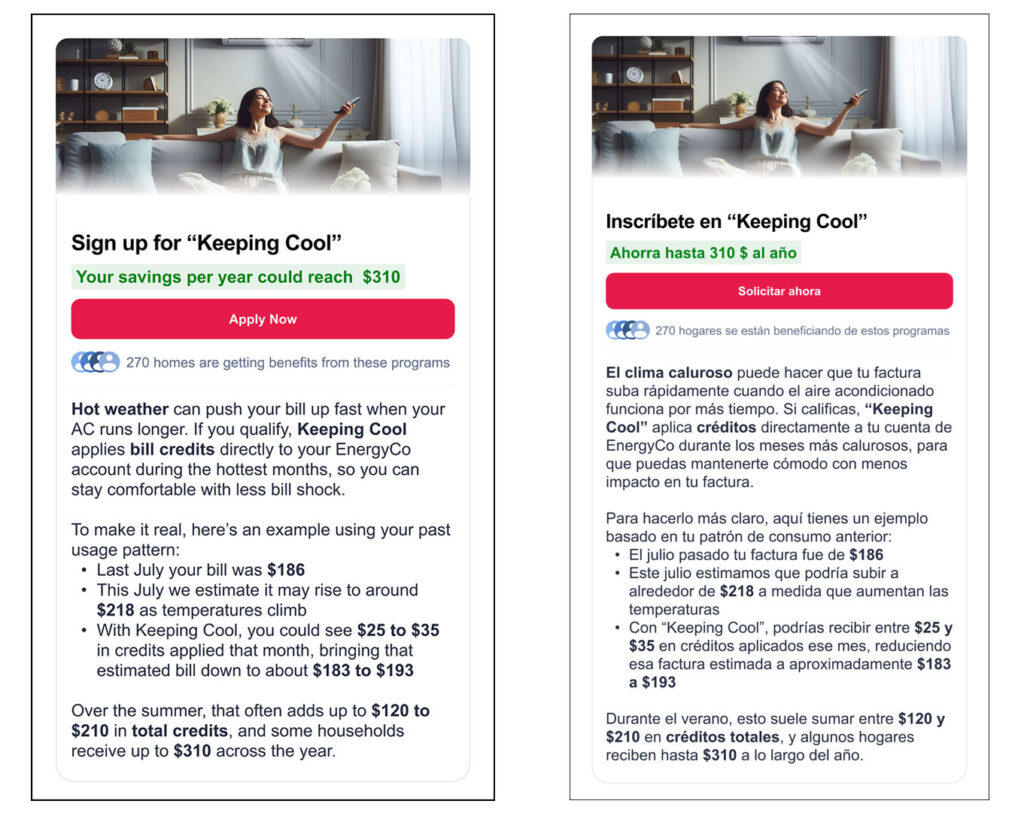
The question remains, how can utilities demonstrate to their customers that they are also a trusted partner with their best interest in mind? Premise-based insights are essential, because they enable personalized communication. But multi-faceted enrollment journeys are also vital to ensure people don’t fall through the cracks. What if someone misses the first email? Or if they only engage via text, or are more comfortable communicating in their native language? What if that isn’t Spanish, but instead Tagalog, or Portuguese, or Ukrainian? You need a system that thoughtfully delivers multiple touchpoints, uses diverse channels, and leans into GenAI to operationalize perfect personalization in their preferred language.
Technology helps here too. Many utilities serve diverse populations where three to five percent of ratepayers speak less common languages. Marketing teams typically translate materials into Spanish, but aren’t able to offer translations into every language their customers speak. With generative AI, you can support less common but still significant language populations without bloating your translation budget.
The goal is meeting customers where they are, through channels they trust, in languages they speak, with outreach that’s persistent but not intrusive.
You can’t improve what you don’t measure. Who’s opening emails? Who’s enrolling? What messaging is working? How are programs performing?
Understanding the metrics behind program performance isn’t just about reporting numbers to regulators, it’s about creating a feedback loop for continual program improvement. Insights from measurement feed directly back into your segmentation and targeting. For example, low engagement from a particular segment might signal that your messaging is off, that you’re targeting the wrong people, or using the wrong channel to reach them.
Measurement closes the loop. It turns your income-qualified program from a one-time campaign into a continuously optimizing engine.
When segmentation, engagement, and measurement work together, program outcomes improve dramatically. You’re not just enrolling more customers, you’re enrolling the right customers who will benefit most and need help most urgently.
This precision matters to deliver on the promise of equity. Income-qualified programs exist to serve vulnerable populations. Premise-level targeting ensures help reaches customers based on actual need, not zip code assumptions. Multi-channel, multilingual engagement ensures language and communication preferences don’t become barriers. And continuous measurement ensures programs improve over time, closing equity gaps rather than perpetuating them.
Ensuring equitable access to energy has always been a complex challenge, and continues to become more so. To better serve the customers in need requires moving beyond simple income thresholds to energy burden calculations, and adding a wider-range of programs for specific populations.
The utilities implementing, diversifying and scaling the most successful income-qualified programs rely on an integrated approach: understanding your customer base at a granular level, engaging them meaningfully, and continuously improving based on what works. This is cohort-of-one eligibility, paired with precision outreach, powered by outcome-obsessed measurement.
That’s the path from program availability to meaningful enrollment. That’s how you demonstrate real value to regulators and ratepayers. And most importantly, that’s how you ensure help reaches the customers who need it most, when and how they need it.
Reach out to our team to schedule a live demo.
Ai is still evolving and may not be perfect. Always verify important details for accuracy.